b)Application
Moment of inertia
- Moment of inertia is the name given to rotational inertia, the rotational analog of mass for linear motion.
- moment of inertia is also depend of axis of rotation and mass distribution of the body.
- The point mass relationship becomes the basis for all other moments of inertia since any object can be built up from a collection of point masses.
- SI unit moments of inertia is kg m2
- It can be represented as I = m r2, where I = moment of inertia kg m2 , m= mass (kg), r = radius (m)
(Question with answer)
Question 1A cable is wrapped around a uniform, solid cylinder of radius 'R' and mass 'M'. The cylinder rotates about its axis, and the cable unwinds without stretching or pulling. If the cable is pulled with a force of 'F' Newtons, what is its acceleration?
Hints
- What is the moment of inertia for a uniform, solid cylinder, with the axis through its center?
- What is the torque exerted?
- What is the relationship between acceleration of the cable, a, and the angular acceleration,
 ?
?
 Diagram of the cable unwinding Diagram of the cable unwindingfrom a cylinder. Answer: Drawing a diagram will aid us in solving this problem; refer to Diagram
|


 =90
=90 , so sin(90)=1.)
Question 2
A rod of mass  and length
  rotates about a fixed frictionless
and length rotates about a fixed frictionlesspivot located at one of its ends. The rod is released from rest at an angle  beneath the horizontal. What is the angular acceleration of the rod immediately after it is released?
beneath the horizontal. What is the angular acceleration of the rod immediately after it is released? 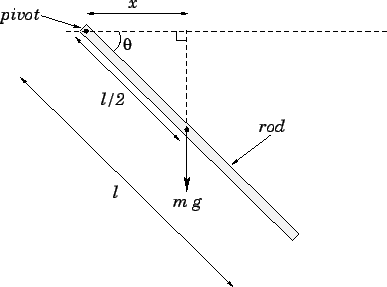
Answer: The moment of inertia of a rod of mass  and length
  about an axis, perpendicular to its length, which passes through one of its ends is
 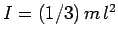 .
.
and length about an axis, perpendicular to its length, which passes through one of its ends is .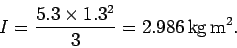




Examples question:
Question 1:
A weight of mass m=4.8kg is suspended via a light inextensible cable which is wound around a pulley of mass M=13.5kg and radius b=0.8M. Treating the pulley as a uniform disk, find the downward acceleration of the weight and the tension in the cable. Assume that the cable does not slip with respect to the pulley.
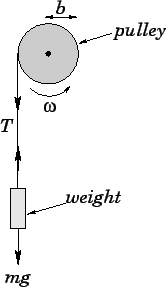
Question 2:
weight of each stone has a mass of 23g and the throw distance of 8.2cm. when thrown into a place, with a speed of 31 m / s in 0.57s. assuming the weight and speed by throwing a stone that is thrown, determine the total torque is working on it.

No comments:
Post a Comment